
Relationships
Jealousy as a guide through life
Article
28 May 2026 · Knud Thorbjørn Hansen, HjerteDialog
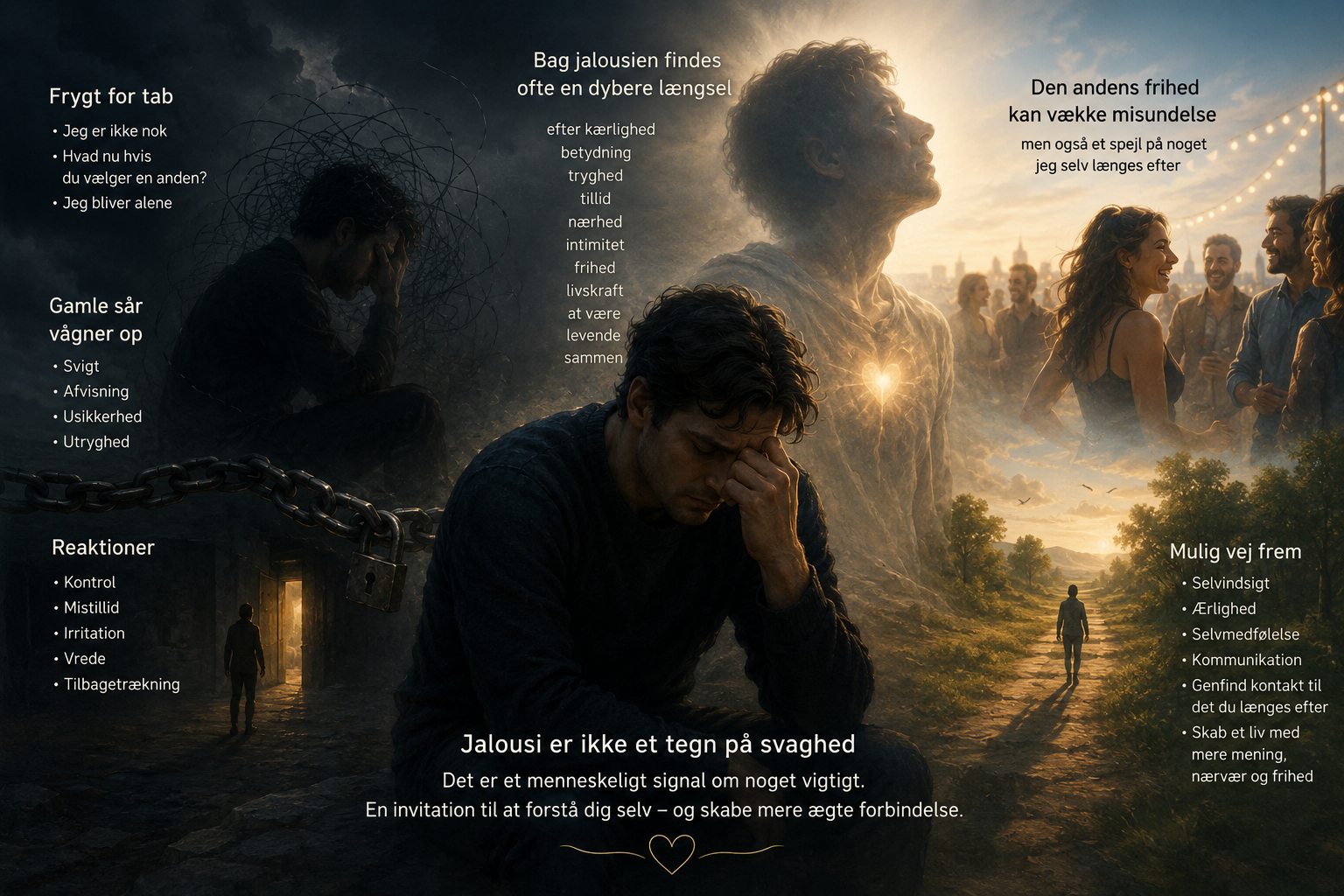
Jealousy is an emotion that many people carry deep shame around.
Often we try to hide it, control it, or explain it away. But behind jealousy, there is often something far more human and profound than most realize. Traditionally, jealousy is understood as: the fear of losing the one you love. And that is often part of the truth. But sometimes, jealousy also holds something else: longing, sensitivity, envy, grief, the fear of not mattering, and a connection to aspects of life that one misses in oneself. This does not mean that a person is bad, weak, or unwell. On the contrary.
Many people with intense jealousy are not weak people
Many of the people who struggle most with jealousy are often those who have shown immense strength throughout their lives. They may have: survived difficult childhood conditions, carried too much responsibility too early, learned to manage on their own, stood emotionally alone, developed a fierce willpower and independence, fought their way through life's burdens, and been the pillar that others leaned on.
Many of these individuals are not fragile. On the contrary, they are often strong, independent, and remarkably resilient. At the same time, beneath that strength lies a profound sensitivity. A tenderness that perhaps never had safe conditions in which to live and unfold. A person may have learned to protect this sensitivity through: hyper-control, fierce self-reliance, strength, autonomy, temperament, distance, achievement, and hypervigilance.
Love is not lacking in someone who struggles with jealousy; on the contrary, love often means the world to them.
When the other steps out into life
Some people feel jealousy particularly strongly when their partner or someone they love: goes out, is social, appears free and alive, receives attention, moves effortlessly in social spaces, seems light, spontaneous, and full of life.
In the person struggling with jealousy, this can awaken: the fear of being chosen against, the fear of not being enough, the fear of losing importance, and the fear of standing alone.
Sometimes it can also evoke something else — a kind of envy: “I long for some of that life myself.” Perhaps a longing for: freedom, spontaneity, lightness, vitality, social safety, joy, the feeling of being alive, wanted, and connected, deep human connection, and reciprocity.
When jealousy also holds envy
Some forms of jealousy are not only about the fear of losing the other person. They can also carry a more hidden and painful realization: “You are moving in a place in life that a part of myself deeply longs for.”
In such moments, the other person's freedom becomes more than relational insecurity. It also becomes a mirror reflecting aspects of life they themselves may miss connecting with. This does not necessarily mean wanting to live the exact same life as the other. Rather, it is a longing for something the other embodies or possesses, such as: more liveliness, freedom, joy, greater connection to one's own needs, freer access to spontaneity, and deeper human openness and closeness.
When this longing is not conscious, it can easily express itself as: control, irritation, criticism, distrust, anger, and distance. Envy, then, is not necessarily a sign of a flawed human being, but often a sign of: a person longing for more within themselves and their own life.
Jealousy is often stronger when the nervous system is under strain
When a person has been burdened for a long time by: stress, uncertainty, emotional pressure, past betrayals, shame, loneliness, loss of identity, and exhaustion, the nervous system becomes far more sensitive to risk and comparison.
A partner's nights out are no longer simply: “an evening out.” Subconsciously, they can be experienced as: a risk of loss, competition, possible rejection, a threat to the relationship, a threat to one's perceived self-worth. This does not necessarily mean the feeling is rational. But it is often profoundly real for the person experiencing it.
The culture of comparison and modern restlessness
Modern human beings simultaneously live in a culture shaped by constant comparison. Through social media and digital communities, many people compare: their own inner life with the external and often idealized lives of others.
People see: others' joy, freedom, relationships, external success, and social lives, without seeing the full picture: the loneliness, doubt, conflict, pain, and insecurity behind the facade. For many nervous systems, this creates an almost chronic feeling of: not quite being enough.
Behind the control, there is often love and fear
Many people grow hardened in their jealousy because, at the same time, they feel: alone, restless, inadequate, insecure, and terrified of loss. For many, it can be hard to express: “I get scared that I won't matter anymore,” or “I long to feel more alive myself.”
Therefore, the emotion is often translated into: anger, control, vigilance, distance, silence, and criticism. But behind that reaction often lies a person who: loves deeply, feels intensely, reacts strongly to distance, and longs for safe connection.
The deeper longing behind jealousy
Behind much jealousy lies not only fear, but a profound human longing. A longing to: matter, be desired, be loved, rest in trust, experience true reciprocity, and feel alive together with another human being.
For many people, relationships are not merely about security or sexuality. They are about the longing for: deep connection, emotional openness, honesty, devotion, intimacy, human closeness, and the experience of being fully oneself.
When these longings have previously in life been met with betrayal, distance, criticism, unpredictability, and emotional loneliness, a person may begin to protect themselves through: control, withholding, vigilance, distance, and fierce autonomy. Not because the longing is small — but because the longing is so vast.
Perhaps, therefore, jealousy is sometimes less about the desire for control and controlling the other — and more about the fear of never fully gaining access to the deep human connection one longs for.
Jealousy can cause great suffering
People who live with intense jealousy often suffer more than those around them understand. Thoughts can become: looping, obsessive, exhausting, and anxious. A person can lose: peace of mind, presence, trust, freedom, and joy of life. Relationships can be worn down by: distrust, control, conflict, surveillance, repeated assurances, lies, and emotional turmoil – and the person struggling with jealousy blames themselves.
Note: Understanding the background of jealousy does not mean that controlling or boundary-violating behavior becomes healthy or acceptable. Feelings are human. But a person still carries responsibility for how these feelings are lived out in relationships.
Envy is not necessarily something ugly
Envy only becomes truly destructive when people feel ashamed of it, deny it, project it onto others, or attack themselves for feeling it. If the person can instead say: “Something in me longs for that life, too,” then envy can become an important guide.
It can reveal something about: one’s own needs, forgotten aspects of the self, a longing for vitality, the need for more freedom, joy, or human connection.
Perhaps maturity is not about never feeling jealousy
Perhaps maturity is rather about being able to feel and own one’s emotions without hating oneself for them. And perhaps also about being able to feel and express jealousy or envy without making the other person wrong.
When a person dares to meet the feeling with honesty and curiosity, jealousy can slowly be transformed from struggle, control, and fear into self-insight, connection, genuine connection, deeper self-understanding, and a more honest love.
Perhaps, then, healing is not about never feeling jealousy or envy. Perhaps it is about gradually being able to meet these emotions with greater dignity, honesty, and self-compassion — so that the relationship no longer has to bear alone the longing that the person must also reconnect with within themselves.
Questions for reflection
◆ What is it that I am truly afraid of losing?
◆ When do I feel most meaningful in relationships?
◆ What does the other person's freedom or joy of life awaken in me?
◆ Are there aspects of life I myself long to be more connected to?
◆ When do I feel truly alive myself?
◆ What might my need for control be trying to protect?
◆ Which experiences from my life are being activated in these situations?
◆ How can I meet my sensitivity with greater dignity and less self-criticism?
◆ How can I speak more honestly about my fear without attacking the other person?
Closing remark
Jealousy does not necessarily mean a lack of love. Sometimes it means that something deeply important is at stake within a person. Not a weak person. But a person who loves, feels, and is profoundly touched — and who perhaps longs for: more life, more freedom, more trust, more human closeness, and a deeper connection to themselves and to others.
By Knud Thorbjørn Hansen · HjerteDialog.dk
Knud Thorbjørn Hansen · HjerteDialog.dk
Do you need someone to talk to?
Take the first step – together we will find out how I can help.
Book the clarifying phone call